Getting traffic but no sales? 12 reasons and how to fix them
Short answer
When a website gets traffic but no sales, the cause is usually one of three things: the wrong visitors (traffic that was never going to buy), a page that doesn’t convince the right visitors (unclear offer, no proof, no visible next step), or friction that stops them at the last step (surprise costs, a slow or broken checkout, a long form). Check them in that order.
Key takeaways
- First check the traffic: where it comes from and whether those people could ever buy.
- Then check the first screen: can a stranger tell what you sell, why it’s better and what to do next in five seconds?
- Then follow one visitor to the end: cart, checkout or form. Most money is lost in the last steps.
- Fix the biggest leak first, measure it, then move to the next one.
Start here: is it the traffic or the website?
Before changing anything, find out where your visitors come from and where they leave. Open your analytics and look at two things:
- Sales or leads by traffic source. If one source brings lots of visits and zero sales while others convert, the problem is that traffic, not your site.
- Where people drop off. Product page views, add to cart, checkout started, purchase. The step with the biggest drop is where to look first.
If every source converts poorly and people drop off on the first page, the website is the problem. The 12 reasons below cover both.
Reasons 1 to 3: the traffic is wrong
- Visitors were never going to buy. Blog readers from another country, broad ad audiences, bots or giveaway hunters. Check the countries, devices and pages people land on. A spike in visits with a very short time on site is often bot or low-quality traffic.
- Ads promise something the page doesn’t show. Someone clicks an ad for a discount or a specific product and lands on your homepage. They can’t find what they clicked for, so they leave. Every ad should land on a page that continues its promise. See message match.
- You send paid traffic to the homepage. A homepage talks to everyone. A landing page talks to the person who clicked one ad. See landing page vs homepage for paid traffic.
Reasons 4 to 8: the page doesn’t convince
- Visitors can’t tell what you sell. A big photo and a slogan like “Quality you can trust” say nothing. The first screen should say what it is, who it’s for and why it’s better, in plain words.
- No price, no next step on the first screen. People want to know what it costs and where to click. If they have to scroll to find out, many won’t.
- No proof. Reviews, ratings, results, customer photos, logos or guarantees. Strangers need a reason to trust you before they pay.
- The site looks dated or broken. Low contrast, stray characters, missing images or a cookie banner covering half the screen make a small brand look risky.
- It doesn’t work well on a phone. Most visitors arrive on mobile. Check your own site on your phone: is the button visible, is the text readable, does everything load?
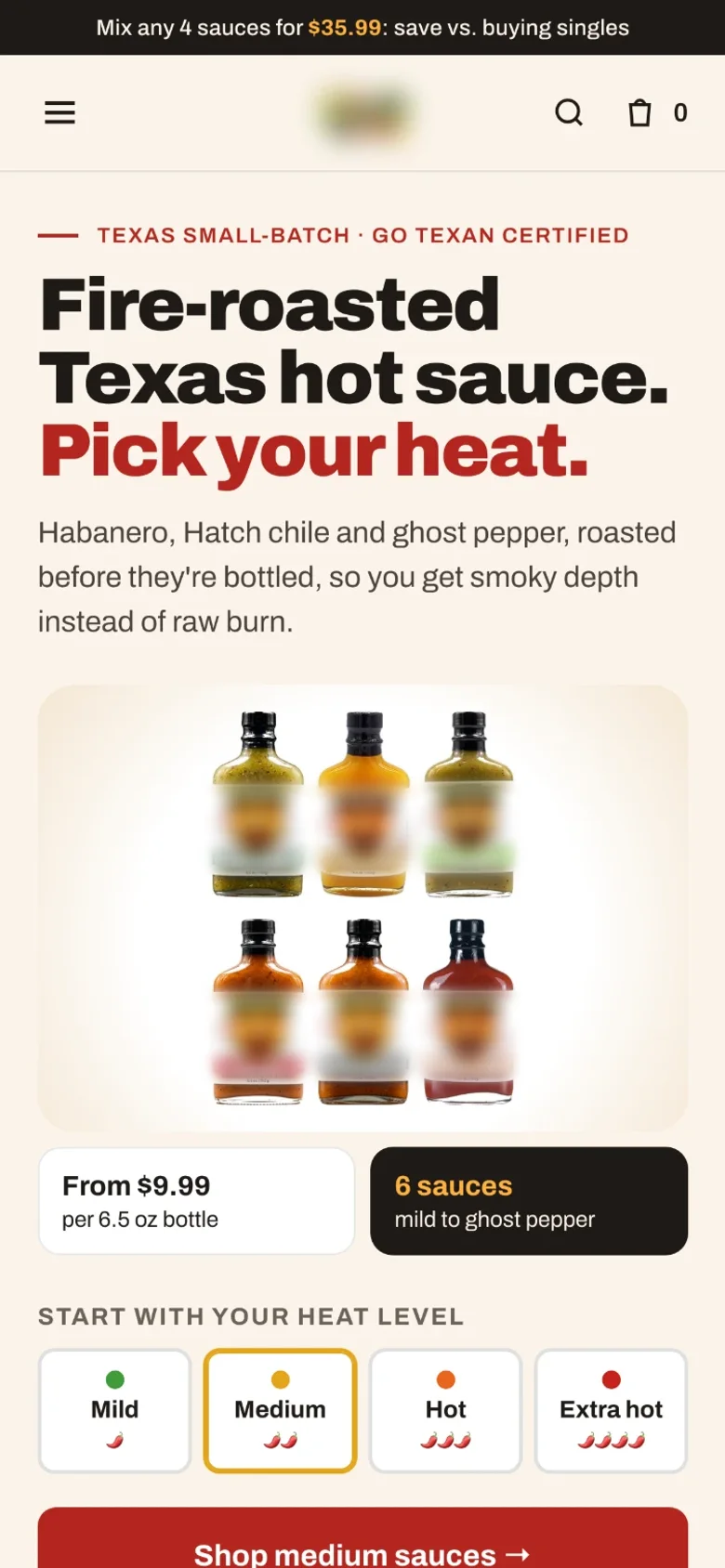
Here is what fixing reasons 4 to 6 looked like on a small-batch hot sauce store. The old homepage opened with a photo slider and no button. The new one shows the whole range, prices and a heat picker on the first screen.

Reasons 9 to 12: something stops them at the end
- Surprise costs at checkout. In Baymard’s 2026 survey, 40% of US online shoppers had abandoned a purchase because extra costs like shipping and tax were too high. Show shipping costs and free-shipping thresholds early.
- Forced account creation. 18% abandoned because the site wanted them to create an account. Offer guest checkout.
- A long or complicated checkout or form. 17% abandoned because of a too long or complicated checkout. Cut every field you don’t need.
- Errors and slow pages. 17% abandoned because the website had errors or crashed. Test your own checkout and forms on a phone, start to finish, every month.
See also why people add to cart but don’t buy.
How to fix it, in the right order
- Find the biggest leak with your analytics: the source or step where most people disappear.
- Watch real sessions. Free tools like Microsoft Clarity show recordings of visitors. Ten recordings of people who left usually show the problem.
- Fix one thing at a time, starting with the step closest to the money.
- Measure the result. Compare sales or leads per visitor before and after, or run an A/B test if you have enough traffic.
Want to see what fixing it could be worth? Put your numbers into the CRO calculator.
Want me to find the leak?
I find where your visitors drop off, design and build the fix, and test it, so you see exactly how many more sales it brings. One person, from research to a live page. See how I work →
FAQ
Why does my website get traffic but no sales?
Usually the wrong traffic, a page that doesn’t explain what you sell and why it’s better, or friction at the end such as surprise shipping costs, forced accounts or a broken checkout.
How many visitors should it take to get a sale?
It depends on your industry, price and traffic source, so compare against your own past numbers and against each traffic source. If you are far below what you used to get, something changed or broke.
Can bad traffic cause no sales?
Yes. Bots, broad ad audiences and visitors from countries you don’t ship to can bring lots of visits and no sales. Check sales by traffic source before changing your site.
What should I fix first?
The step with the biggest drop that is closest to the money, usually the checkout, cart or form, then the first screen of the page people land on.
Sources

I’m George (Djordje) Peric, a CRO designer, CXL certified in Conversion Optimization and Ecommerce Marketing. I design websites, landing pages, funnels and ads, and A/B test them.