How a quiz landing page got a solar installer 20% more leads
Short answer
A local solar installer sent all its paid traffic to a quote page whose survey showed “Something went wrong”. I designed a new Meta ad and a landing page that continues it, with a 4-step quiz that starts in the hero and asks for contact details last. In a 3-week A/B test with the same ad, the new page converted 20% more visitors into leads and cut the cost per lead by 15%.
Key takeaways
- Check that the form works before anything else. Here, every paid click landed on a broken survey.
- Build the ad and the landing page together, with the same promise, photo and button.
- Start the quiz on the first screen with the easiest question, and ask for name and phone last.
- Replace big claims with specific facts the business can back up.
- Judge the page on cost per lead and lead quality, not only on clicks.
The problem: paid clicks with no way to convert
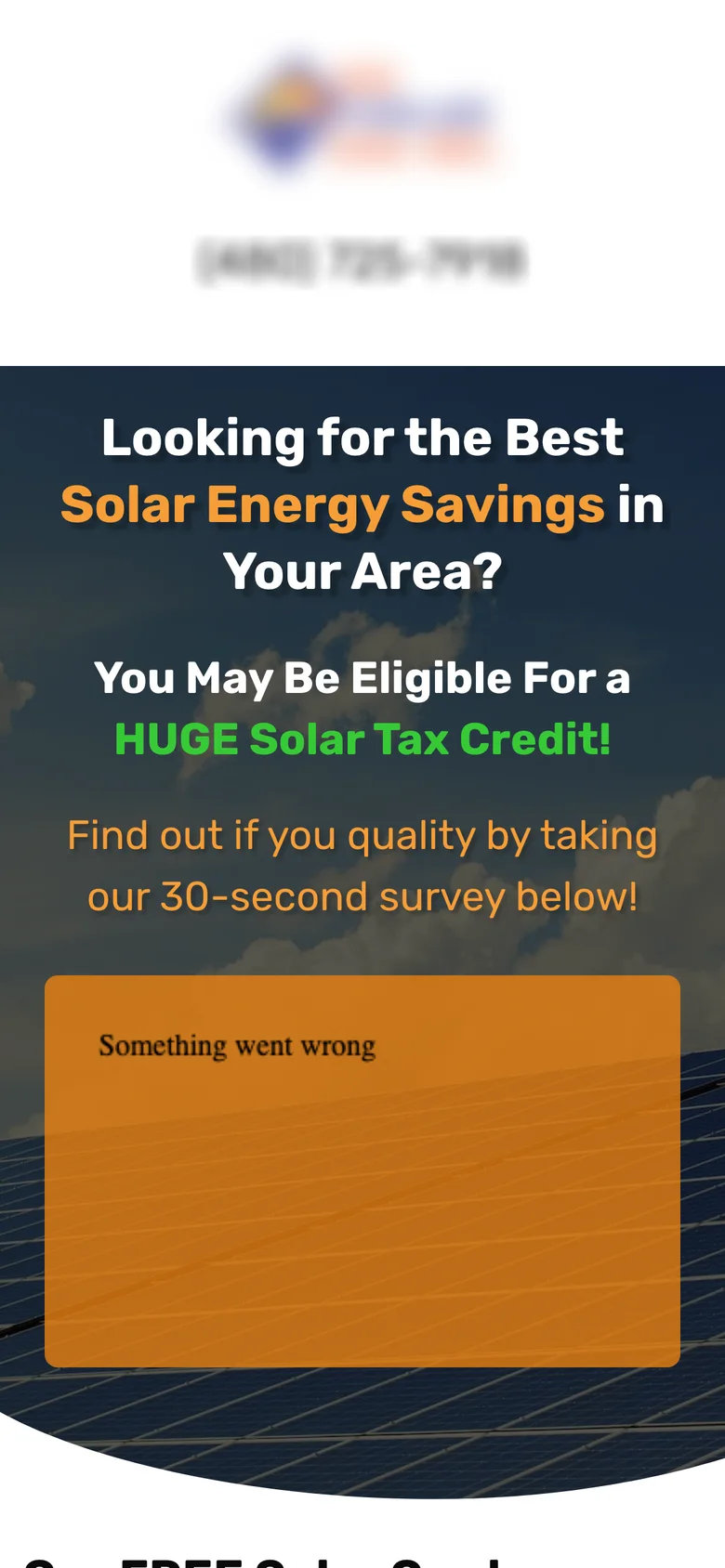
The quote page that every “Get a free solar quote” button pointed to was broken. Where the 30-second survey should have been, it showed “Something went wrong”, on desktop and on mobile. Anyone who clicked an ad could only call the phone number or leave.
The main promise was also out of date. The homepage and the quote page both led with a “HUGE Solar Tax Credit”, but the federal residential credit ended for systems installed after 2025. Building ads on it would have been inaccurate and risky.
Smaller trust problems added up on top: a typo in the subhead (“find out if you quality”), a browser tab title with another company’s name, the same reviewer name on two testimonials with different cities, a “save up to 75%” claim with nothing behind it, and the full site menu on a page meant for ad traffic.
Step 1: an ad with a promise the page can keep
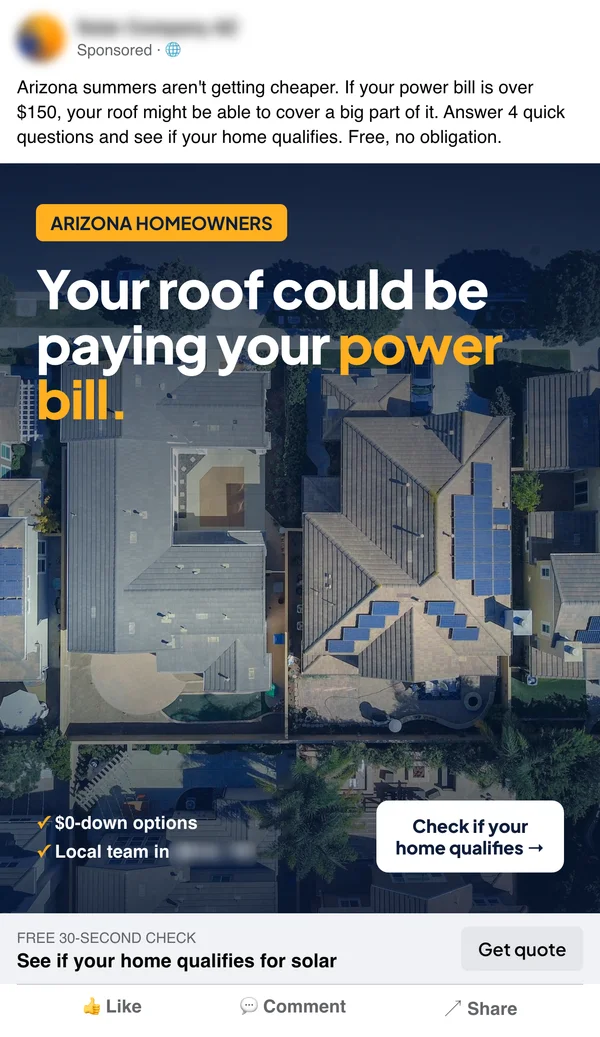
I started with the ad, because the landing page has to continue whatever the ad promises. There were no recent ads to build on, so I designed a Meta feed ad around something that doesn’t depend on the tax credit: rising power bills and $0-down options.
- Headline: “Your roof could be paying your power bill.”
- Who it is for: a clear label for local homeowners, so renters and people outside the area don’t click.
- Button: “Check if your home qualifies.”
Step 2: the page repeats the ad
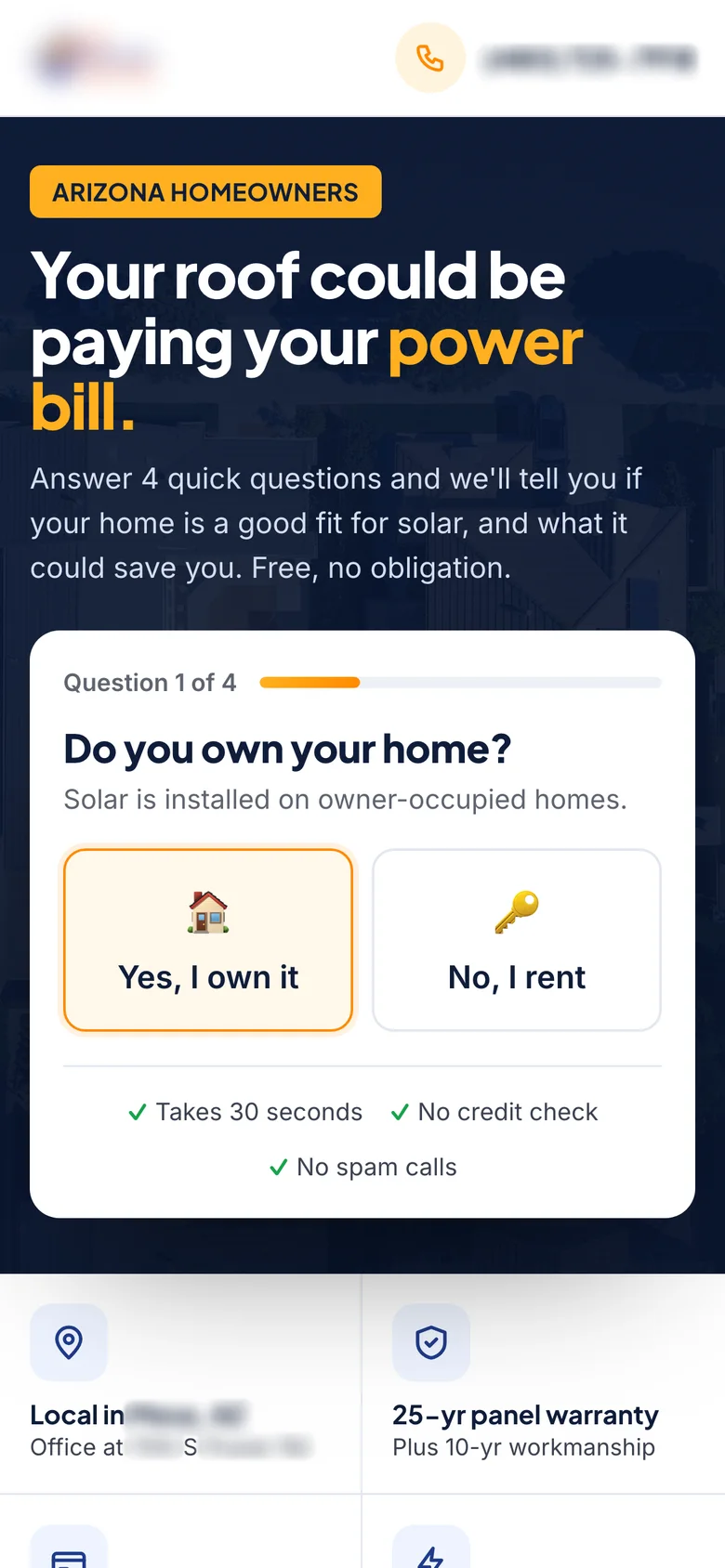
The landing page uses the same headline, photo, homeowner label and call to action as the ad. Visitors decide in a second whether they landed in the right place. When the page looks and sounds like the ad they just tapped, they keep going. I wrote more about this in ad to landing page message match.
Step 3: the quiz starts in the hero
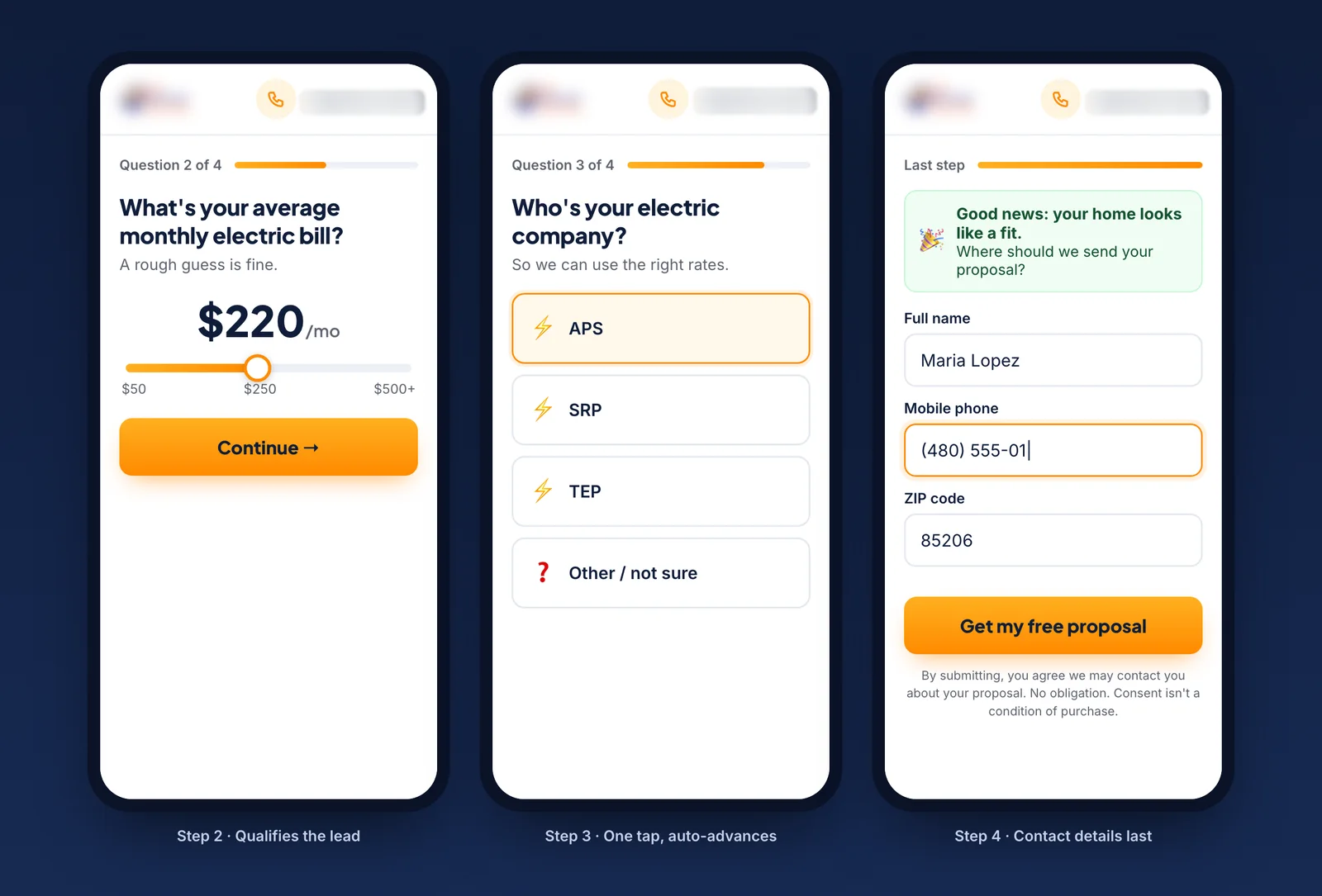
The first question sits on the first screen and takes one tap: “Do you own your home?” It is the easiest possible action, and it is right where people look first. The four steps go from easy to personal:
- Own or rent, one tap.
- Monthly power bill, on a slider.
- Electric company, one tap.
- Name, mobile and ZIP, with clear consent text.
Easy questions build momentum. By the time people reach the contact step, they have already put in some effort and want to see the result. That is the main reason multi-step forms often beat one long form; see multi-step vs single-step forms and how I design quiz funnels.
Step 4: facts instead of big claims
I replaced the unproven claims with facts from the installer’s own site: a local office, a 25-year panel warranty and a 10-year workmanship warranty, $0-down options and a 1 to 2 day install. Specific, checkable facts are more believable than “save up to 75%”, and they hold up if a customer asks about them later.
Step 5: one job for ad traffic
The page has no menu and one goal. The phone number stays visible for people who would rather call. A short “what happens next” section in 3 steps takes away the fear of a pushy sales call, and the call to action repeats at the bottom for people who read everything first.
How I tested it
The same ad sent traffic 50/50 to the old quote page and to the new landing page for 3 weeks.
- Primary metric: landing page conversion rate, from visitor to submitted lead.
- Business outcome: cost per lead.
- Early signals: quiz start rate and drop-off at each step.
- Guardrail: lead quality, meaning homeowners with a qualifying bill, and booked appointments.
The result
The new page won: +20% landing page conversion rate, and the same ad budget brought in leads 15% cheaper. Most of that came from giving paid visitors a working first step they could take in one tap, on a page that kept the ad’s promise.
What you can copy for your own lead generation page
- Click your own ads on a phone, today. Fill in the form to the end. Broken forms and dead buttons are more common than most owners think.
- Check every promise is still true. Old offers, ended incentives and claims nobody can back up cost trust and can cause trouble.
- Write the ad and the page as one piece. Same headline, same photo, same button.
- Put the first question on the first screen, and keep contact details for the last step.
- Measure cost per lead and lead quality, not just form starts.
If your landing page gets clicks but few leads, my list of 10 reasons a landing page doesn’t convert is a good place to start. For budgets, see how much landing page design costs.
Want this for your ads?
I design the ad and the landing page together, build the page, and A/B test it against your current one, so you see how many more leads it brings and what each lead costs. See my landing page design services →
FAQ
Do quiz landing pages work for solar leads?
In this test, yes: a 4-step quiz that started in the hero beat the old quote page by 20% in conversion rate and cut cost per lead by 15%. The quiz worked because the first step was one easy tap and contact details came last.
How many steps should a solar quiz have?
This one had 4: own or rent, monthly bill, electric company, then name, mobile and ZIP. Each question should either qualify the lead or make the result more useful, and contact details should come last.
Should a solar ad send traffic to the homepage?
Usually not. A homepage talks to everyone and links everywhere. A landing page that repeats the ad and has one goal gives paid visitors a clear next step.
What should I measure on a solar landing page?
Landing page conversion rate as the main metric, cost per lead as the business result, and lead quality, such as homeowners with a qualifying bill and booked appointments, so cheaper leads are not worse leads.
Sources

I’m George (Djordje) Peric, a CRO designer, CXL certified in Conversion Optimization and Ecommerce Marketing. I design websites, landing pages, funnels and ads, and A/B test them.